4

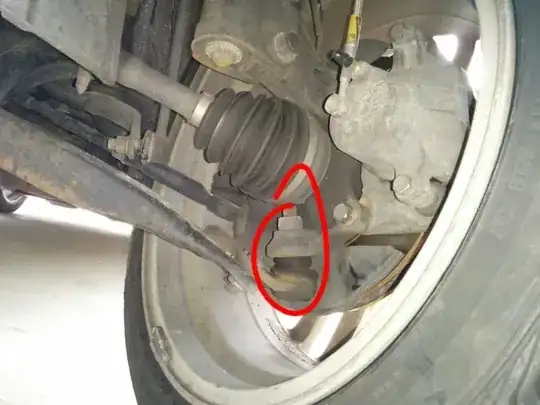
ball joint... 15 degrees of play here

So I've replaced this ball joint and still get play going over bumps and with the steering wheel turned all the way to one side or another-- you can rock the wheel and get about 15 degrees of play in that ball joint.

I'm trying to visualize the geometry and where the extra tolerance exists that is leading to this rocking/popping I hear. I'd like to insert a metal shim or washers somewhere to tighten up ... Whatever it is that's got extra play...to prevent the tire from rocking on the ball joint axis but I have yet to figure out where exactly the problem is. I'm having difficulty visualizing the geometry involved.

paIncrease
  • 211
  • 1
  • 2
  • 5
  • Make, model and year of the vehicle? – Gabriel Mongeon May 28 '14 at 10:08
  • Can you describe the play? Grabbing the wheel/tire at the 9 o'clock and 3 o'clock position does the movement allow the tire to wiggle left to right? Or can you move the steering wheel 15 degrees before the tires move? – mikes May 28 '14 at 10:31
  • Scion tC 2006. 9 and 3 position no. I'm actually having trouble getting the tire to do the movement. Before the joint was replaced I saw the old joint swiveling about 20 degrees when the steering was all the way to one side and you pushed on the wheel (don't recall what positions). Note back then it was definitely a swivel. It wasn't like the joint was popping in and out or up down or anything. Back then the popping noise was really bad and the car wouldn't track straight. After the joint was replaced still the same noise albiet quieter from same spot but car tracks straight now. – paIncrease May 28 '14 at 22:27
  • This popping noise is the only thing besides some camber wear on the pass front tire that is leftover after the accident. I'd hate to get rid of a perfectly good vehicle just because the noise annoise me. – paIncrease May 28 '14 at 22:27

2 Answers2

2

If you replaced the lower ball joint and are still getting massive movement out of the wheel, I'd suggest your wheel bearing is bad. With the strut suspension, you shouldn't be having that much movement on the vertical, even with a bad ball joint. A bad ball joint will only give you movement at the bottom, where you should only see maybe 1-2 degrees of deflection. The other areas of the suspension where you might see any type of deflection are the bushings at the base of the lower A-arm, where it meets the frame rail. Secondly, there should be a hard rubber piece at the top of the strut. Either of these places would not allow for as much deflection as you are suggesting, again 1-2 degrees, if you could even get it to move with your hands. Which leads me back to the wheel bearing(s). These are the ones in the hub (depending on the vehicle, it could be one or two sets there).

EDIT:

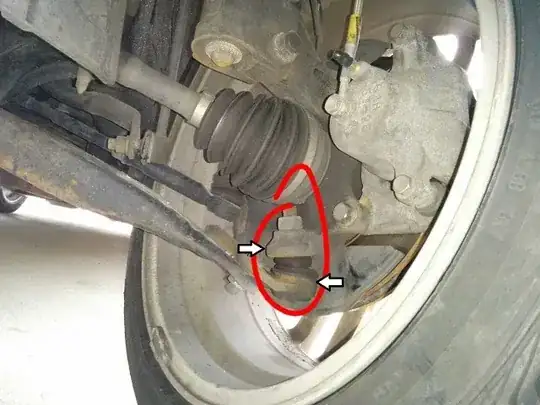
To detect the ball joint deflection, look at the below image. You'll see movement between these two pieces in your lower A-arm and spindle (where the two arrows are):
enter image description here

If there is any lateral movement here, it's bad, and needs replaced. The ball joint should allow free twisting movement, but should not allow lateral movement. In order to see if this is deflecting, you need to do the following:

  • Jack the front end off of the ground
  • Support the car on a jack stand while leaving the A-arm with the ball joint completely unsupported, and the tire about 3-4" off the ground
  • Place a board (2x4 over 4 feet in length - or some such which is similar) under the tire from the front of the vehicle, with about 6-8" of board to the back side of the tire (board should be inline with the vehicle at this point)
  • Using the board as a cantilever, lift the board so the tire becomes supported
  • Move the board to the left and right while observing the ball joint area
  • Check for deflection
Pᴀᴜʟsᴛᴇʀ2
  • 156,290
  • 29
  • 252
  • 491
  • I've checked the wheel bearing. I feel like something is out of place by a little? What's to guarantee the ball joint doesn't rock/pivot to begin with? – paIncrease May 28 '14 at 18:06
  • @Rancur3p1c ... check my edit. This method should allow you to help find the problem area. 15 deg of deflection is a lot of movement. It should REALLY be evident where this movement is coming from. – Pᴀᴜʟsᴛᴇʀ2 May 28 '14 at 19:02
  • The ball joint is supposed to allow pivoting is it not? So why would pivoting mean it's bad? – paIncrease May 28 '14 at 22:18
  • http://www.aetnascrew.com/sw1000.jpg – paIncrease May 28 '14 at 22:18
  • The pivoting is what I saw in person before replacement, and after heard the same noise albeit less pronounced – paIncrease May 28 '14 at 22:19
  • The lateral movement you describe is pivoting through joint range of motion no? – paIncrease May 28 '14 at 22:29
  • I'm unable to produce any movement or noise in the ball joint using a 7ft 2x8 from the left, middle, or right of the tire. :(. As the tire goes into the well the joint changes angle to accommodate the a frame control arm changing angle but that's it. – paIncrease May 28 '14 at 22:45
  • Or with the tire fully to the left/right. Tire moving into well about 3" – paIncrease May 28 '14 at 22:56
  • @Rancur3p1c ... I think we are talking about two different things. I think you are talking about the left/right movement of the tire as you are looking at it, which would not be the ball joint, but possibly the tie rod end, that is if there is a problem at all. Think steering issue instead of a suspension issue. I don't know though, as your description has me totally confused now. – Pᴀᴜʟsᴛᴇʀ2 May 29 '14 at 01:26
  • Just saying that even with tire turned all left/right I'm unable to make the joint move given any 2x4 forces. – paIncrease May 29 '14 at 02:12
  • @Rancur3p1c ... at this point I think you are focusing on the wrong thing. From your description, there isn't a problem with the ball joint ... something else is going on which has you bothered and I'm not able to decipher what the heck it is. If there isn't any deflection when correctly using my method above, there should be no problem with the ball joint. Is there any way to link a video of the exact problem you are seeing? – Pᴀᴜʟsᴛᴇʀ2 May 29 '14 at 10:26
  • Well i can't actually see it anymore... :( i just know i saw it before the joint was replaced and it made the exact same noise albeit quieter now and the joint could pivot by applying pressure to the wheel. But yes i feel like somewhere else there is slack or extra tolerance which is allowing this. But i don't understand all the geometries involved to be able to say "i should add some washers to the ball joint's control arm mount." – paIncrease May 31 '14 at 00:33
1

You may need an assistant to move the wheel while you observe where the movement is occurring. I would first check the balljoint stud. If the tapered hole in the spindle is worn or the nut was not tightened to spec you may get some movement there. Verify that the movement is coming from the ball joint as @ Paulster has suggested. The movement may be in the tierod ends or control arm bushing if you do the balljoint test incorrectly.

mikes
  • 19,921
  • 2
  • 26
  • 49
  • Control arm bushing is something I haven't considered. The tie rod is solid the only play laterally at 3 and 9 is from the steering column – paIncrease May 28 '14 at 22:04
  • Nut is tightened all the way. The spindle is right up against the ball joint support flange below it. – paIncrease May 28 '14 at 22:30