37

I recently made the Yale lock on my front door much easier to open by spraying some WD-40 in there.

However, I just saw this question on WD-40 not being a “true” lubricant, and wondered whether it was appropriate to use on Yale locks?

Paul D. Waite
  • 565
  • 1
  • 5
  • 7
  • 6
    Is the fact that the lock is Yale pertinent to the question? Perhaps the question text could be changed make the question more general. – Chris Cudmore Jun 02 '11 at 14:35
  • 1
    @chris: it’s Yale locks that I need to lubricate, so yes, it is. If all locks need the same lubrication then it could be made more general, but equally having “Yale” in there helps people find it if they’re searching for Yale lock lubrication advice. – Paul D. Waite Jun 02 '11 at 16:46
  • 5
    WD-40, not a true lubricant. It has a lot of solvent, is a water displacer used to slow down corrosion. While it is momentarily lubricating, most of it evaporates, the oily film left behind is to seal out water. – Fiasco Labs Feb 08 '13 at 17:18
  • 1
    @Paul saying your lock is a Yale lock is not particularly useful or descriptive. Yale make many kinds of locks as do many other manufacturers of locks. Some Yale locks will have more in common with say a Lockwood lock than other Yale locks. It's superfluous at least and confusing I think. – wide_eyed_pupil Oct 29 '16 at 06:45
  • 1
    It's superfluous at least and confusing I think unless you're to mention the exact model of lock. – wide_eyed_pupil Oct 29 '16 at 07:00
  • 1
    @wide_eyed_pupil: gotcha. Unfortunately I don’t live at the same place any more, so I can’t confirm the model. I’m not sure how it’s confusing (it was a lock made by Yale, just like a car made by Ford is a Ford car), but I can understand it’s not detailed enough to be useful. – Paul D. Waite Oct 29 '16 at 13:31

5 Answers5

22

OLD ANSWER (Improved below)

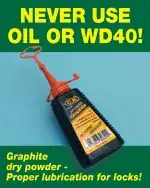
Graphite powder is the preferred lubricant for locks. You should be able to get it at any hardware store in a squeeze bottle that is half air, allowing you to blow it right into the keyway. You are going to have to wait a while before putting it on, as the residual WD-40 will gum it up.

EDIT: As per MrSquonk's comment below -- Try coating the key and work it in slowly. It's less messy.
enter image description here

LATE EDIT: Comment below edited into the answer. Please read full comment thread.

Yale USA says:

Yale® KeyMark® cylinders are lubricated from the factory with a Teflon® lubrication. Cylinders should be lubricated periodically depending upon environmental conditions and usage. LAB Lube is the approved lubricant. Caution: It is not recommended to lubricate cylinders with oil or to mix lubricants. "

LAB Lube

  • Micronized polytetrafluoroethylene (PTFE) Powder

  • A dry white powder lubricant that will not "cake-up" as graphite does.

  • A superior friction-fighting agent
Chris Cudmore
  • 14,129
  • 7
  • 59
  • 89
  • Excellent, cheers Chris, good to know. – Paul D. Waite Jun 01 '11 at 14:31
  • 9
    Whilst I agree in principle, my experience is that attempting to 'blow' graphite powder into a Yale lock with such a bottle results in more graphite powder outside of the lock than in. I'm quite happy with graphite, oil or WD40 but I always coat the key with whichever of them I'm using and gradually work it into a Yale lock to free it up. – MisterSquonk Jun 02 '11 at 00:34
  • @MisterSquonk -- Good Tip. – Chris Cudmore Jun 02 '11 at 13:11
  • 4
    If you've put WD-40 in there, you will probably need a locksmith to pull it apart and clean it. – staticsan Jun 03 '11 at 06:35
  • 1
    Worth looking at @GrahamWilliamson's answer below which contains contrary advice issued by Yale themselves. – tomfanning Jan 31 '13 at 13:19
  • @tomfanning Interesting. – Chris Cudmore Jan 31 '13 at 15:07
  • 3
    @tomfanning which is contradicted by other Yale divisions that offer Yale branded graphite lock lubricant. – Fiasco Labs Jan 31 '13 at 17:00
  • Yale USA says: Yale® KeyMark® cylinders are lubricated from the factory with a Teflon® lubrication. Cylinders should be lubricated periodically depending upon environmental conditions and usage. LAB Lube is the approved lubricant. Caution: It is not recommended to lubricate cylinders with oil or to mix lubricants.

    "
    LAB Lube

    •Micronized polytetrafluoroethylene (PTFE) Powder •A dry white powder lubricant that will not "cake-up" as graphite does. •A superior friction-fighting agent "

    – Chris Cudmore Jan 31 '13 at 17:12
  • @ChrisCudmore - Yes, that would be a much better lubricant than graphite and trumps use of any petroleum distillate. Look for LAB Locksmith Lube, made with DuPont Teflon powder. Recommended for all locksets. I've just been turned on to something I'd recommend over Graphite. – Fiasco Labs Feb 08 '13 at 17:06
  • I've read many sources online from manufacturers and locksmiths that say do not use graphite to lubricate locks. – Jason Jun 15 '16 at 18:08
  • @staicsan http://www.brunswicklocksmith.com/locksmith/wd-40-facts-and-myths/

    "I’m often asked if it’s “OK” to spray WD-40 into a lock or into a keyhole or keyway. The answer is ABSOLUTELY YES! There are many misconceptions about WD-40 that have been around for years,…"

    – wide_eyed_pupil Oct 29 '16 at 06:48
  • are these LAB lubricants environmental pollutants? given how much ends up outside the lock when people try and apply direct from bottles rather than using a key, I wonder if it's worth the bother if they have environmental issues, teflon is carcinogenic to humans when it separates from a pan (why you should never use a knife in a teflon pan) – wide_eyed_pupil Oct 29 '16 at 06:52
  • @wide_eyed_pupil Sorry to necromance, but teflon does not cause cancer. There's some evidence that it may be good for you. – Riet Nov 14 '17 at 20:35
  • Confession of a WD-40 maniac - I didn't even thing about it, just sprayed plenty into my YALE lock. It's sticking, difficult to insert the key in from one side, impossible from the other side... No clue how to get WD-40 out, so will be ordering a new lock. Well... I learned an expensive lesson - DO NOT WD-40 locks. (I have previously done this to other types of locks, and they survived it fine... just maybe the more expensive / complicated locks should be avoided) – Peter Perháč Aug 22 '22 at 10:11
7

This page on YaleDoor.co.uk

http://www.yaledoor.co.uk/blog/post/2012/05/01/Home-Door-Lock-Maintenance-Tips.aspx

Says the opposite ... "Any, “all purpose” oil or lubrication will do the job, but be sure never to lubricate your door locks with powder graphite, as it will do more harm than good. Simply insert the straw (which is normally supplied with lubricants such as WD40) into the lock cylinder and spray away! "

Now I'm confused

  • Huh. That is odd. I know I used WD-40 on my front door's Yale lock, and it subsequently got a bit sticky, then broke 18 months later. No idea if the two facts were related though. – Paul D. Waite Jan 31 '13 at 12:09
  • 5
    Which is hilarious because Yale South Africa recommends their Yale brand Just-A-Puff Graphite for lubricating locks. To be applied every 2-3 weeks under extreme conditions. http://www.yalelock.co.za/en/Internal-Pages/Archive/yale-Africa/ProductsDB/?groupId=470&productId=8859 Oil based lubricants attract dirt and oxidize into a gummy substance after while, leading to the tumblers sticking. – Fiasco Labs Jan 31 '13 at 16:45
  • 2
    My local locksmith recommended WD40 (but for a mortice lock). I was surprised as I know it is controversial as a lubricant. The WD40 website says "WD-40® can ... lubricate locks, hinges, & all moving parts" but they're not exactly reticent about the wonders of their product. – RedGrittyBrick Jan 31 '13 at 17:22
  • We've got one better on the floor. LAB Locksmith Lube. Micronized PTFE powder, doesn't cake like graphite, doesn't oxidize into sticky goo and attract dirt like petroleum products. – Fiasco Labs Feb 08 '13 at 17:14
  • I use lithium based grease, it lasts longer than wd-40 and the graphite powders and serves as a moisture barrier. only problem is, if the lock is used in a dusty environment, the lock will attract dust particles. Still my locks work perfectly all the time (probably over 50 locks) – Hightower Dec 04 '13 at 09:33
  • 1
    Was that link from the manufacturer, Yale? The yaledoor.co.uk link is now 404 Not Found, and the whole site is "Sash Windows of London" – Xen2050 May 10 '17 at 23:54
7

For locks that are in such bad shape that one is unable to get graphite powder in it, you can first use a little bit of LPS 1 (Greaseless lubricant). Do not use any kind of silicone lube, that's FAR worse than WD-40 (I had a guy come in with a couple locks he'd done that to, it ended up costing him a good bit of labor for me to undo that mess)!

Brian Knoblauch
  • 1,087
  • 3
  • 15
  • 27
  • 1
    +1 on the LPS1 greaseless. I've used it before on a door that got a lot of rain that kept washing the graphite out. Doesn't attract dirt. – Fiasco Labs Jan 31 '13 at 17:00
  • Can you provide references for the advice not to use silicone lube? I found other sources saying silicone is fine for locks, e.g. http://www.naturalhandyman.com/iip/infxtra/infsil.html, http://www.dummies.com/how-to/content/how-to-lubricate-a-door-lock.html so I don't know who to believe. I just lubricated two house door locks with silicone so I hope they're right. – LarsH Mar 20 '15 at 18:00
2

Think of WD-40 as a very good cleaning agent, not a lubricant. If you use WD-40 to lubricate anything, it will probably stick/squeak again in the near future. Myself I use a silicone spray in lock cylinders. Graphite or PTFE might be better or worse, I don't know.

Satyen
  • 121
  • 1
2

I just spoke to someone at Yaledoor in their technical department and they advised, 3-in-1 or another 'light engineering oil'.

ShoeMaker
  • 633
  • 4
  • 13