1

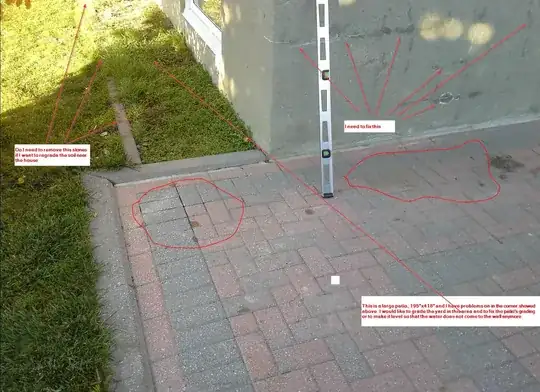
I am not sure if the sand was washed away by the water that is going under the patio in that corner or the bedding material is simply missing here. The paver below is from the left circled area in the second photo. That corner is actually raised a little bit which is the opposite that should happen if the sand was washed away from under the paver. So ...what material was used for bedding here? Can I say that the bedding is missing?

enter image description here

enter image description here

MiniMe
  • 3,402
  • 22
  • 87
  • 146

1 Answers1

2

It's hard to tell from the picture but it may be -1/4" crushed gravel that was used as bedding. We used that quite often in place of a mortar type sand because it didn't compress as much but still allowed easy grading and workability.

BD72
  • 342
  • 4
  • 9
  • Any concerns regarding permeability to water compared with regular bedding sand? – MiniMe Nov 12 '14 at 17:52
  • because it is coarser than masonry sand it is most likely a little less absorbent but water would flow through either easily. – BD72 Nov 12 '14 at 18:06
  • That is my concern that it might release the water to the underlying layer too quick and that layer will flood> – MiniMe Nov 12 '14 at 18:36
  • I'm not clear on "That layer will flood"? Are you worried about standing water on the pavers? The moisture is supposed to run off and run through the pavers. What is the layer below your sub-base? Is it clay? It should flow away from the house and down into the ground. What are you hoping for? – BD72 Nov 12 '14 at 21:50
  • I think that I read somewhere (pavingexpert.com) that sand is better because it releases the water gradually into the sublayers, alowing them to drain. If the sublayers flood somehow (in my case because the water pools in settled areas) the pavers will move because the sublayers have water and the pavers lose the base – MiniMe Nov 13 '14 at 01:04
  • Another concern that I have with this type of bedding is also mentioned on the above site, and that is that this type of aggregate does not go up in the joints to lock the base of the pavers. The sand does. The jointing sand finishes the job when it is poured into joints from above – MiniMe Nov 13 '14 at 01:05
  • You said "water pools in settled areas" so you mean a low spot in the pavers? Yes it will settle there, it is a low spot. That is why you screed it to help keep it level. If you have a low spot or it settles then simply pull up pavers all around the low spot and float in some extra sand. That will eliminate the low spot and allow water to flow across the slope. – BD72 Nov 13 '14 at 05:00
  • With regard to locking in the base of the pavers, we always finished by spreading a fine sand, masonry, silica, etc. very finely over the top of the pavers and then running a plate compactor over the pavers this worked the jointing sand into the joints tightly. If we ever had to pull up the pavers the base sand had always worked up into the cracks or rather the pavers had compacted down into the sand except in the joints, thus filing in the joints. That is just my personal experience 5+ years on a paving crew in Sun Valley, Idaho, USA. – BD72 Nov 13 '14 at 05:08