Had electric inspected today and only thing inspector said was that my grounds were messy on a metal box (still code but messy). 3-gang box with three light switches running in different directions. How would you tie them in together to both look neat and have room for everything?
Asked
Active
Viewed 7,924 times
3

-
2I would tie them all together in one nut, spliced to an extra wire that goes to a green screw in the box. What did yours look like? (pics?) – BlueRaja - Danny Pflughoeft Sep 06 '13 at 21:02
-
I had one wire wrapped on box screw. One wire out from that and then all others nutted together from there. Boxed up and being drywalled right now. – DMoore Sep 06 '13 at 21:22
-
Perhaps he would have liked to see the solution labelled "Reduce the Number of Pigtails" in this answer: http://diy.stackexchange.com/a/26576/14416 where one continuous wire is used and wrapped around the correct terminal on each switch. – Sep 06 '13 at 21:27
2 Answers
3
This is where copper crimp connectors come in handy.

Lets say you have a 3 gang box, with three cables entering, and three devices to connect. You also have to bond the grounding conductor to the box, if you're using a metal box. So you might have three grounding conductors entering, but need 4 grounding conductors, and they all have to be bonded.
Leave the grounding conductors from the three entering cables long, and get a scrap piece of bare wire to use as a pig tail. Feed the three grounding conductors through the crimp connector, so that there is enough wire left to connect to the devices. Insert one end of the scrap piece of wire into the connector, then crimp the connector.
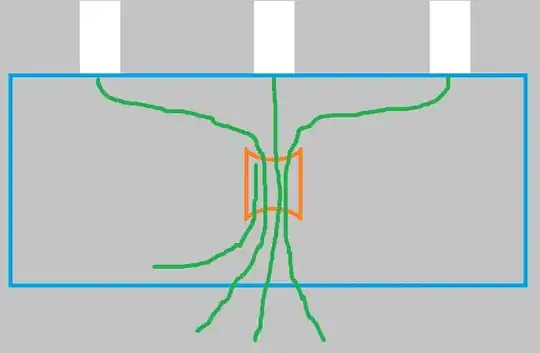
Now tuck the crimped grounds back in the box, and attach the bonding wire to the box (using either a screw or ground clip). Attach one grounding conductor to each device, and you're done.
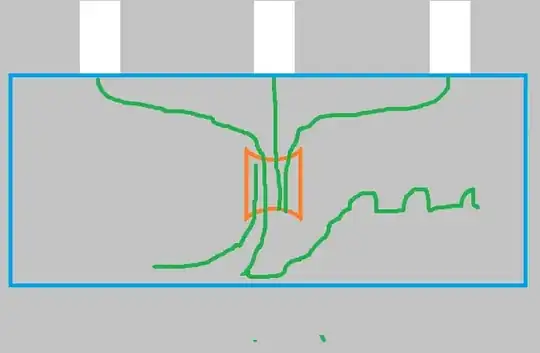
Alternatively, you can leave one conductor really long (while still including the extra bonding conductor), then use that single conductor to connect all the devices.

Tester101
- 131,561
- 78
- 320
- 610
-
When you have to change out one of the devices, and the replacement device (such as a dimmer) has a grounding wire permanently attached to it, how do you add it into the crimp connector? Do you have to cut off the crimp connector and use a new one? – LarsH Oct 19 '19 at 18:39
1
250.148 Continuity and Attachment of Equipment Grounding Conductors to Boxes.
(C) Metal Boxes. A connection shall be made between the one or more equipment grounding conductors and a metal box by means of a grounding screw that shall be used for no other purpose, equipment listed for grounding, or a listed grounding device.
So, if the box holds a lightswitch that has a grounding screw, there's no need to separately ground the box, since the connection with the lightswitch provides the path to ground.
If this is a junction box with no devices, there should be a screw (separate from the ones holding the box up) in the box that you tie the ground to. The typical way to do this would be to run a separate bare (or green) wire from a screw (typically green) in the box, spliced together with all the rest of the ground wires in the box.
It's unclear from your comment, but it sounds like you're grounding to the screw holding up the box - this would be against code.

BlueRaja - Danny Pflughoeft
- 3,506
- 10
- 35
- 57
-
No wasn't grounding to screw holding up the box. Maybe too many pigtails. – DMoore Sep 06 '13 at 21:29
-
It sounds like you either had extraneous grounds (as I mentioned, there's no need for a separate ground for the box if you're hooking up a grounded lightswitch), or extraneous wire-nuts (normally you connect all the grounds in a single, large wire-nut). I'm not sure what "one wire out from that and then all others nutted together from there" means, but it sounds like you used more than one wire-nut for the grounds, which is not against code, but unnecessary. – BlueRaja - Danny Pflughoeft Sep 06 '13 at 21:38
-
1@BlueRaja-DannyPflughoeft From DMoore's comments, I gather that your suggestion in this answer sounds very similar to what he did. It is possible that his inspector would not like your wiring either since there are ways to use fewer wires and reduce the number of pigtail connections as Tester101 points out (which not only looks cleaner, but reduces the total volume occupied by the ground wires and has fewer breaks in the wire which means decreased potential for mechanical failure). – Sep 07 '13 at 14:00
-
2I'd like to see further reference on using a switch as "equipment listed for grounding". I've never seen a box grounded only via the switch/outlet in it. This seems exceedingly dumb to me -- you're relying on flimsy little screws with a poor connection to ground, not to mention when you remove the switch the box is ungrounded. In fact, that is probably the reason that they have added ground screws to the switches in the first place. Either way, it's not a big deal to always ground the box itself, so why not? – gregmac Sep 09 '13 at 14:03
-
2@BlueRaja-DannyPflughoeft I think you're misinterpreting the code, or maybe thinking backwards. The equipment grounding conductor must always be bonded to a metal box. If a device is listed and labeled as 'self grounding', then that device may be able to be installed in a metal box that is properly bonded without attaching a separate grounding conductor to the device. The device is grounded through the yoke, but the box is still grounded whether or not the device is installed. The grounding of the box cannot rely on a device to being connected. – Tester101 Sep 10 '13 at 20:09
-
3*250.148 (B) Grounding Continuity. The arrangement of grounding connections shall be such that the disconnection or the removal of a receptacle, luminaire, or other device fed from the box does not interfere with or interrupt the grounding continuity.* – Tester101 Sep 10 '13 at 20:12
-
@Tester101: What I said is correct. The code directly says "A connection shall be made between [..] grounding conductors and a metal box by means of [..] equipment listed for grounding" - there is no way to interpret that as what you said. As for 250.148 (B), that is referring to the continuity of the grounding circuit; that is, removing a receptacle should not cause other receptacles farther down the line to lose grounding. – BlueRaja - Danny Pflughoeft Sep 10 '13 at 20:23
-
1@BlueRaja-DannyPflughoeft There are no receptacles and/or luminaires "listed for grounding". – Tester101 Sep 10 '13 at 20:26
-
2The equipment the code is talking about is ground screws and ground clips. – Tester101 Sep 10 '13 at 20:26
-
As for 250.148(B), that means removing a device (receptacle, luminaire, etc.) cannot cause the box (and anything else downstream) to not be grounded. – Tester101 Sep 10 '13 at 20:29
-
See 250.188 "Types of Equipment Grounding Conductors" for the full list of what the NEC considers "equipment listed for grounding". This section does not list any receptacle as a valid grounding device. – Sep 11 '13 at 13:25
-
@statueuphemism: An "equipment grounding conductor" (the cable) is different from "equipment listed for grounding." They are even both mentioned separately in my above quote 250.148(C) – BlueRaja - Danny Pflughoeft Sep 11 '13 at 15:43
-
1@BlueRaja-DannyPflughoeft You are correct. Re-reading, it looks like anything that is listed per the applicable standards (stating something like "UL-467 listed" on the packaging - http://ulstandardsinfonet.ul.com/scopes/scopes.asp?fn=0467.html) in your area will satisfy the requirement of "equipment listed for grounding". – Sep 11 '13 at 19:51