4

I want to strengthen the floor of my office. Currently the joists are 2"x5" (actual size).

I want to put a 2"x8" (1.5"x7.5" actual size) which will double the existing joists. I will have to reduce the height of the new joists from 7.5" to 5" at the ends.

Will I have to reinforce the end to prevent the beam from splitting? What could I use to reinforce the ends?

the floor of my office


After all your answers and comments, i want to put a draw to illustrate the final solution. A good idea is obvious afterthought, but not before! enter image description here

La Raison
  • 155
  • 7

2 Answers2

3

I'm reading this as the office is over the crawl space and you want to add the 8" joists so that the floor height is unaffected.

You say

I will have to reduce the height of the new joists from 7.5" to 5" at the ends.

I say you don't, and if you do, it will compromise your attempt to strengthen your floor.

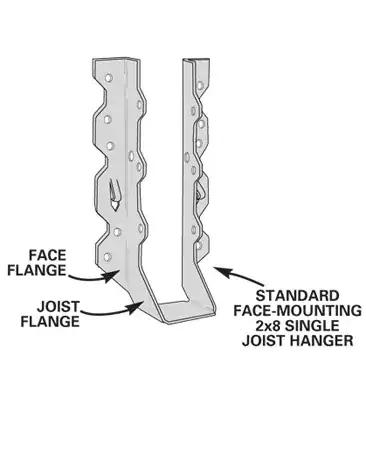
Get joist hangers:

enter image description here

Instead of sistering your joists to the old 5", hang the new 8" (ie: 7.5") joists halfway between each 5" joist. Put them tight up against the floor and secure them with the joist hangers (again, tight) and that will reinforce your floor quite nicely without compromising the integrity of the board by cutting them down to 5" at the ends.

The Evil Greebo
  • 25,851
  • 16
  • 90
  • 124
  • Absolutely right, narrowing the ends to 5" effectively makes it a 2X5. – shirlock homes Dec 12 '12 at 22:00
  • The 2X5 "sit on a small wall. Therefore I did not have wood to nail the hanger. (sorry for my english) – La Raison Dec 12 '12 at 22:16
  • The 2X5 "sit on a small wall. Therefore I did not have backing wood to nail the hanger. – La Raison Dec 12 '12 at 22:37
  • 1
    Notching the ends to 5" makes it an effective 2x3 at the end due to shear reduction factors for notching joist ends. We still get 2x8 bending and stiffness strength at mid span, so there is some benefit. @ La Raison: Why not install the backing wood to the wall in the form of a ledger board. Then apply short hangers to hold the 2x8s, or block above the ledger and use full height hangers, depending on the loads involved. – bcworkz Dec 13 '12 at 00:51
  • bcworkz : it's a good idea to put a ledger board. Do you know how to fix the ledger board? bolt, lag (?) or nail? I have to read about the shear reduction factor. Do you have link about it? – La Raison Dec 13 '12 at 01:54
  • If you could post a picture of what you're working with it'd be a big help. – The Evil Greebo Dec 13 '12 at 13:07
  • La Raison: The shear reduction came from the general framing provisions of a model code used in the US. No online refererence I know of, sorry. It is partly to account for inevitable poor workmanship and over cutting the notch. If you bored a hole in the corner and cut carefully, I could be convinced to to not apply the reduction. I mentioned hangers on a ledger to stay on topic of the answer, but it's better to simply place the ledger under the new joists. If this to be attached to concrete, any number of expansion anchors would work. Lags with shields could work, but nails no. – bcworkz Dec 13 '12 at 23:53
  • Another reason for the shear reduction is the end of the board could have a defect that is allowable for 2x8 boards but would normally be grounds for rejection in a 2x5 board due to it's size in proportion to the board. – bcworkz Dec 14 '12 at 00:11
1

I will second the idea of a ledger, particularly after looking at the diagram. Anchor a 2"x6" to the concrete wall using [concrete screws, expansion bolts, epoxied all-thread,powder-actuated fasteners, you choose the method that works best for you] at 7 1/2" below the subfloor. Then you can rest the new joists on top of the ledger. May I recommend that with a thirteen foot span a 2"x10" will be significantly stiffer than a 2"x8".

Also the idea of sistering the joists to existing undersized ones is a good one for two big reasons: 1) you are reinforcing the subfloor at the location of the existing subfloor to joist attachments, 2) you have the opportunity with a bit of construction adhesive and some 10d commons to essentially make an engineered joist that is stronger and more rigid than either the new 2"x8" or the old 2"x5" would ever be (additively).

Good luck with your project!

Paul
  • 842
  • 1
  • 6
  • 10