It is generally not advisable to hack on life safety systems. That being said, the question of the details of the wired-interconnect protocol remain open. I wanted to discuss that protocol here for those who are curious.
Original "dumb" smoke detector interconnect sounds the siren on all interconnected smoke detectors when a 9-to-12 volt (referenced to neutral/white) direct-current signal is continuously present on the signal wire (red). This still how pretty much all interconnected smoke alarms indicate a fire condition.
However, modern interconnected detectors are capable of detecting carbon monoxide and other conditions. When these conditions are signaled, they must be identified as something other than a smoke alarm by the other detectors. Ideally, any dumb smoke detectors sharing the interconnect signal should ignore these signals, even if they weren't designed with such multiplexed-signaling in mind.
Kidde came up with such a mechanism in 2000 and apparently patented it (6,791,453; Now possibly expired...?). While I think a patent on something like this is pretty silly, in this case, it is good news for us because it means we have some documentation!
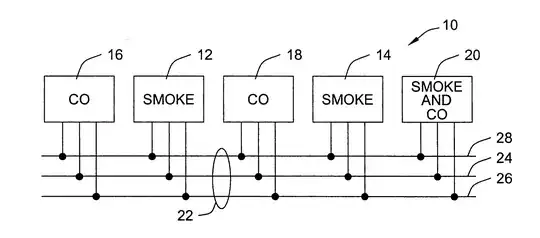
From the abstract (emphasis mine):
Presented is a communications protocol for use by interconnected hazardous condition detectors, such as smoke and carbon monoxide detectors for use in dwellings and other structures. This communications protocol provides conventional signaling to indicate the presence of a smoke condition necessitating the generation of a smoke temporal pattern by all interconnected detectors. The protocol further defines a signaling method by which conventional smoke detectors that are incapable of providing temporal patterns other than that required for a smoke alarm condition will not be sent into an alarm mode of operation upon receipt of a signal other than the conventional smoke alarm signal. This communications protocol defines a pulsed signal to indicate a non-smoke alarm condition that is of a duration that will not trigger the conventional smoke alarms. To allow for the transmission of multiple hazardous conditions alarm notifications, as well as the transmission of additional hazardous condition detector control signals, the communications protocol utilizes a multi-bit signal transmitted via the conventional single signal I/O wire of currently existing interconnect wiring. Through the use of an 8 bit alarm signal, multiple hazardous conditions may be signaled as well as operating modes such as test, hush, reset, low battery, etc. Also presented are smoke, carbon monoxide, and combination hazardous condition detectors that utilize the communications protocol presented herein.
So their protocol has two big features:
- Allows an 8-bit alarm-type indication to be expressed on the signal wire. This enables supporting interconnected devices to be able to detect such conditions as being distinct from a smoke alarm.
- Such non-smoke alarm indications are structured in such a way as to not cause dumb interconnected smoke alarms to sound when a non-smoke-alarm signal is expressed on the signal wire.
Unfortunately the patent does not include a table of codes and their associated meanings, other than 10100101 meaning a carbon-monoxide alarm. However, it does cover the basic theory of operation and protocol encoding. The information in the patent seems to cover more than enough to allow the sufficiently-motivated to reverse engineer any undocumented details.
Again, this is a life-safety system. Hacking on it means you are taking your life (and potentially the lives of others) in your hands.
Addendum Regarding 1-Wire
To explicitly answer your question about if they are using 1-wire, the answer is that they are not. The 1-Wire protocol is not suitable for this use case for a number of reasons:
- 1-Wire requires a bus master. All communications on the bus are initiated by the master. Individual devices on the bus cannot communicate with each other directly, and unless the master has selected a specific device it cannot communicate at all.
- Residential AC power wiring is too noisy for the 1-wire protocol to work properly over the required lengths of cable.


