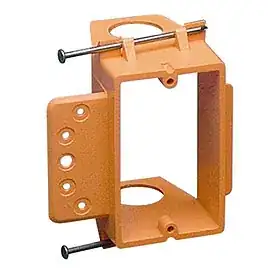
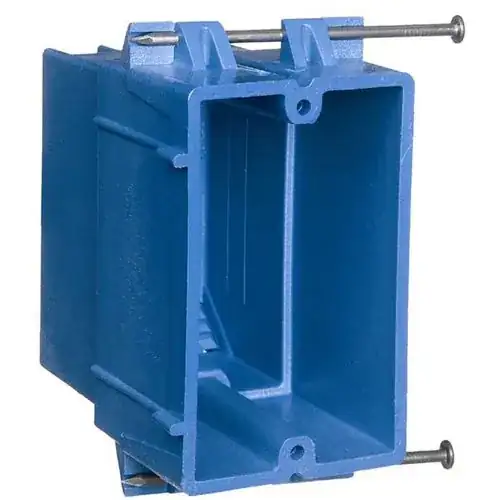
"No Volume Limit" Advantage of Open-back Boxes
The open-backed boxes have the advantage that they don't limit the termination area's volume to the size of the box. Here are a few scenarios where having more volume than what a box provides is important:
- In the case where the structured cable will be run directly to a device in the room (think speakers), the distance of cable needed in the room is spooled in the wall at rough-in and stays there until it is needed (you can cover it with a blank plate to make it tidy until you really need it). Because the slack doesn't protrude from the wall, it does not interfere with or get damaged by installation of sheet rock or other wall material.
- Where you have a high-density of terminations at the wall plate (think 6x keystone jacks in a single-gang box) the minimum bend radius requirement of cat5/5e/6 cannot be honored in a closed-back box. The slack required to make the terminations needs to go behind the wall plate which will result in a very tight coil of cable in the box at best, or will outright not fit at worst. Open-backed boxes solve this problem because the wall cavity can be used to house the slack.
- Using an in-wall active termination device like this might require more volume than a closed-back box. The box would need to accomodate the bulk of the electronics plus the slack required for termination without violating the bend radius requirements of the signal cable.
Note that on exterior walls vapor barrier and insulation will limit the volume available to you, but likely far less so than a closed-back box.
Vapour Barrier
Where I live (Canada) it is customary and code-acceptable to use "vapor barrier boxes" (pre-formed poly cups shown here) behind all electrical boxes on exterior walls whether open- or closed-back. A regular closed-back box does not provide its own vapor barrier any more than an open-backed box.
This method comes from the building code decree that "thou shalt not compromise vapor barrier with wiring." The vapor barrier boxes are taped to the wall's vapor barrier, and wires are puttied to the vapor barrier boxes where they penetrate.
Insulation
I have seen no issues with the combination of open-backed boxes and fiberglass or mineral-wool insulation. Assuming a proper vapor barrier is installed around the boxes, there should also be no issue with spray-type insulation.