I have a single switch for ceiling fan and overhead light. I’m looking to wire to a two switch plate so I can run independently.
Asked
Active
Viewed 9.5k times
7


-
3Hello, and welcome to Stack Exchange. You'll probably need to run a new wire to the fan/light. Would you post a picture of the interior of the switch box, with the wires laid out clearly? – Daniel Griscom Nov 29 '18 at 17:40
-
The line cable (consisting of line hot, neutral, and ground) can enter the switch and fan/light circuitry either in the wall switch box or in the ceiling box. Do you know which case you have? What is the current rating of the breaker that protects the circuit? Your wire is copper and not aluminum, right? What is the size of the wire: #12 or #14? – Jim Stewart Nov 29 '18 at 19:47
4 Answers
3
Assuming that you currently have 2 wires (plus ground) going from switch to fan, you will need to do the following:
Add a 3rd wire. If you have individual wires then you just run another wire (make it a different color from the existing wires) through the conduit from the switch to the fan. But it is quite likely you have a /2 cable - black (switched hot) + white (neutral) + ground in one cable. In that case, replace the cable with a /3 cable - black (switched hot 1), read (switched hot 2), white (neutral), ground.
Remove the existing switch. You may need a bigger box to properly handle 2 switches - that is based on box fill rules, which I conceptually understand but I am not an expert on that.
Attach the black wire (hot) from the panel to either the common hot connection on the switch (some dual switches include a common hot connector, which makes things easier for situations such as this one), or wire nut (pigtail) the black wire with two short black wires and attach each of those to the hot of a switch.
Connect each of the two switched hot wires (typically one black, one red) to the switched hot screw on a switch.
Use a wire nut to connect the panel white neutral to the neutral wire going to the fan/light.
In the fan/light junction box, connect each switched hot to one of the hot wires on the fan/light. Note that the colors may vary - typically black, red or blue.
In the fan/light junction box, attach the white wire (neutral) from the switch box (which is connected to the white from the panel) to either the common neutral connection on the fan/light (some fan/light combinations common neutral connector, which makes things easier for situations such as this one), or wire nut (pigtail) the white wire to the separate white (neutral) wires for the fan and light.
In both switch box and fan/light box, all grounds should be connected (wire nut) together.
Note that this is based on panel/power -> switch box -> fan/light. If your configuration is panel/power -> fan/light -> switch box then the setup will be a little different.

manassehkatz-Moving 2 Codidact
- 115,769
- 11
- 130
- 326
2
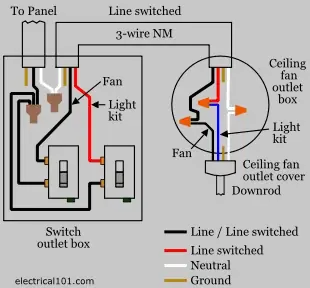 This is the diagram that was used to confirm my same need. You may need to get some 14-3 or 12-3 wire to rewire. That is what I had to do to bedroom ceiling fan because it was wired with 12-2. This photo helped me better understand along with detailed instructions. You will need the 12-3 wire from the switches to the ceiling fan, only. Plus, this diagram assumes the power to the ceiling fan originates from the switch.

KCB3rd
- 89
- 1
- 1
- 9
1
The other answers cover the most correct way to achieve this, but I just wanted to throw it that sometimes, running a new wire is not worthwhile. That has been the case for me. I instead just bought a ceiling fan with remote control, which allows you to switch light and fan separately. These often come with a wall mount for the remote, so it can just be mounted next to the switch.

PhilippNagel
- 4,947
- 17
- 40
-
1That is actually quite common now for ceiling fans with lights. But not always, and the instructions I've written up (and the diagram posted by KCB3rd) are applicable for exhaust fans with lights as well. So it all depends on what equipment you are working with. – manassehkatz-Moving 2 Codidact Dec 02 '18 at 01:05
0
Many years ago, you could buy a fan motor/light control module that was wired between the AC source and the fan motor with a third wire to the light. Upon application of the power, the light would come on. When the AC power was toggled, the light shut off and the fan motor was turned on. When toggled a second time, both fan and light were energized.
IMO, that was a near perfect way to control the fan and light from a single switch, without an extra control. Sadly, it appears they are no longer available.

Doug H.
- 1