14

I have a barstool that has lost several examples of the screw pictured below, and I do not have calipers to measure it precisely. The screw is pictured atop a U.S. quarter coin.

Since the condition of the screw is imperfect, I should mention that I think this is an example of an internal hex screw (I am new to this nomenclature).
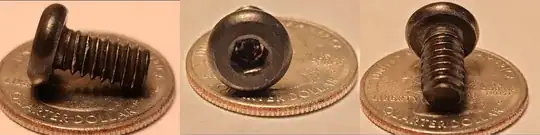
What kind of screw is this?

The barstool from which this originated is very similar in appearance to this example sold by Lowes and this example featured on the Bed Bath & Beyond website.


EDIT 2023.09.06: I must thank everybody for the interest and advice and also apologize for the poor quality of the pictures I posted.

I know that I needn't stick to the exact same type of screw, but I thought that some people might still be curious what it is. I found some calipers at work, and the following (not-to-scale) diagram shows my measurements to three significant digits.
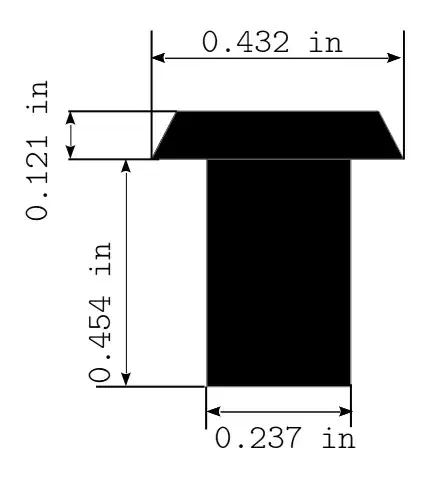
Measurements

I did some novice-level research (search engine), and judging by examples I found, I suspect the following describe some qualitative features.

  • Pan head
  • Hex socket
  • Black oxide finish
Imperial measurement Equivalent metric measurement (to 3 significant digits)
0.432 in 11.0 mm
0.121 in 3.07 mm
0.454 in 11.5 mm
0.237 in 6.02 mm

Based on the finish and the examples I found online, I suspect that the 6.02 mm measurement should be interpreted as 6 mm and that this is an M6 screw. Combining this with what I saw available online, I suspect that this is an M6 x 12 mm screw.

Joe Mack
  • 243
  • 1
  • 7
  • 1
    I don't know if anyone is going to try to figure out the screw size from the photos, but for what it's worth, if someone were to try to do that, it would be much easier if both the leftmost point and the rightmost point on the quarter were visible in the photo. In the first photo and the third photo, the rightmost point is visible but the leftmost point is not, which means it would be rather difficult to try to use the quarter to determine the scale of the photo. – Tanner Swett Sep 05 '23 at 12:05
  • 2
    @TannerSwett it's somewhat trivial to continue the ellipse of the quarter outside the bounds of the photo. – Steve Sep 05 '23 at 22:02
  • Just FYI, the weight capacity of the bar stools to which you linked is only 200lbs. I don't know how they define "weight capacity", but when one initially sits on a chair, the initial load is substantially greater than one's body weight. Either way, I thought you might like to know before investing any time/effort working on them. – End Anti-Semitic Hate Sep 06 '23 at 08:43
  • Get yourself a bunch of Allen keys - one of them will fit the bolt, allowing you to find the size of driver key. Won't help you with the pitch/diameter of threads, though. – Jeremy Boden Sep 06 '23 at 13:45
  • 2
    There are ~330 M Americans, and the world population is ~8 B, so only 4.2 % of the world has US currency. Better to photograph with a ruler in the image whereever possible. Ideally ruler should be in the same plane as the item too because parallax. – Criggie Sep 06 '23 at 19:15
  • Also, when you go to the hardware store anyway, do yourself a favour and get a caliper. – gerrit Sep 07 '23 at 07:58
  • @JeremyBoden that's a bad idea if you don't know whether it's metric or imperial. Some pretend to fit but round off the screw heads, tool, or both. 3/16" used on M6 (which should take 5mm) is a problem I've often had to deal with, for example. And it's worse on low-head fasteners as there's less engagement depth and it's a smaller tool size to start with. Worse again if you use a ball end – Chris H Sep 08 '23 at 08:38
  • @gerrit thread gauges would be at least as useful here, to measure the pitch which will tell you whether it's metric or imperial. Calipers are more versatile but as we've seen before don't provide a trivial answer without a little knowledge – Chris H Sep 08 '23 at 08:42

3 Answers3

51

The type of drive (hex socket, here) does not matter too much. What matters is:

  1. That this is a machine screw, not a wood screw. (Machine screws generally have blunt ends and fine threads; wood screws generally have pointy ends and widely spaced threads.)
  2. The exact diameter of the threads.
  3. The exact thread pitch (spacing between threads).
  4. That the head has a shoulder, not a cone intended to fit into a countersink hole.
  5. The length (doesn't have to be perfect, but it should not be so short it doesn't engage, and not so long it hits something inside the hole before it tightens down what it's supposed to).

Unfortunately, it's basically impossible to get a good match on threads by eyeballing a photograph. Instead, you'll need to go to your nearest hardware store, and bring the screw.

  1. They will likely have a thread checker, where you can screw your screw into a variety of holes and see which one it fits. Make sure to try both the metric and SAE/USA/inch sets. If it goes in just a little bit and stops then that's not a match — a properly matching screw should be easy to turn for many revolutions.
  2. If you can find other loose screws to try, then just press this one up against another, side-by-side — feel the two to see if they are the same diameter, and look for an even zigzag rather than a moiré pattern if they are the same pitch.
  3. The staff will almost certainly be happy to help you find a match.

It's quite likely that you won't get a brown screw, and it might not be a hex socket screw — but that won't matter except for appearance.

Kevin Reid
  • 4,044
  • 32
  • 30
  • 7
    Perfect answer. I discarded my own when I saw yours. The one part I'll add: A traditional hardware store is best - you hand them the screw and they come back two minutes later with the match. At Home Depot/Lowes/etc. you'll more likely have to spend 15 minutes searching the screw/bolt/etc. aisle to find the match. – manassehkatz-Moving 2 Codidact Sep 05 '23 at 03:20
  • 4
    If you find a match, but noticed that the head doesn't match, might as well just change them all so you don't need multiple tools for the same stool.

    If you don't remove these screws regularly, you might want to buy a bottle of thread-lock (or whatever it is called) to keep them in and not lose them again.

    – Nelson Sep 05 '23 at 03:44
  • 3
    It's almost certainly shiny black rather than brown, and the white balance is off in the photos. That's a low head type, which will make it harder to find. A button head would be a better substitute than a normal cap head. Screws are far cheaper if you buy a bagful, so I'd swap out the lot (probably for stainless) – Chris H Sep 05 '23 at 07:52
  • 2
    Also note that it is ok to buy screws that are longer, since you can cut them down to size. When buying longer ones, pick either ones that are 1-2mm too long (as they may fit in existing holes just fine), or ones 1-2cm longer, as it will be easier to cut them down by clamping on the 'waste' thread length. – Thomas Sep 05 '23 at 12:02
  • 15
    @Thomas Do you think somebody asking a question like this is going to have the tools or skill to cut a screw to length? – T.J.L. Sep 05 '23 at 12:23
  • Not massively important, but I know that type of head as "cheese-head", but pan-head or round-head are both more common, and also suitable. – MikeB Sep 05 '23 at 12:23
  • Re, "the head has a shoulder." What MikeB said! A Google search for "pan head screw" turns up a lot of pictures of similar looking screw heads. – Solomon Slow Sep 05 '23 at 15:04
  • 1
    @T.J.L., Many cheap-o wire cutter/stripper tools can also cut small, soft steel machine screws (e.g., the kind of screws that electricians encounter every day.) https://www.amazon.com/dp/B0953113F7/ – Solomon Slow Sep 05 '23 at 15:10
  • 8
    If it's just a bit too long, a washer can sometimes help - it's a lot easier than cutting a screw. – Flydog57 Sep 05 '23 at 16:25
  • 1
    @SolomonSlow I've tried cutting screws with a tool like that and even squeezing as hard as I could I put barely more than a dent in the screw. – Peter Green Sep 06 '23 at 01:31
  • @PeterGreen you're right. I wouldn't try it for more than 3mm or 1/8" steel and this is probably 50-100% more than that (without having handled US coins in over a decade). I also wouldn't use cutters to shorten a screw I wanted to use (except maybe brass, if I put a die on it first) because they crush it slightly – Chris H Sep 06 '23 at 09:41
  • 1
    Agreed - since its probably holding the seatpan to the frame, the only thing that matters is the thread. The head shape and driver interface is not going to be seen, and even the colour is irrelevant. – Criggie Sep 06 '23 at 19:17
8

So I imported your graphic into a CAD program and superimposed some lines which I measured using .955" as the diameter of a quarter. Scaling in this way, I come up with .256" on the screw diameter. Using the other photo and scaling off the length, I get .515 long. I counted 9-10 threads in the 1/2", and knowing that 1/4" Unified National threads come in 20 and 28 threads per inch, I think it's the former.

I don't think it's metric because my crude scaling indicates that it would be funky for metric: about 6.5mm x 13mm long x (.7 = odd pitch for metric).

So bottom line is, if it's not metric...your screw is likely: 1/4-20 UNC X 1/5 long (Button Head).

ShawnBob
  • 81
  • 1
6

A super crude photogrammetry challenge? Sure, I'll play.

Measure from the underside of the shoulder to the end of the bolt. That should be pretty close to 9mm. At which point I think you have a M6x1.0mm metric screw.

Diameter will be hard to measure properly without tools, but pitch is easier. You can check my result against a metric ruler by seeing if the peaks on the thread line up with the mm marks on a ruler almost perfectly.

Pierre
  • 61
  • 1
  • 1
    Since it's sitting on a US quarter, it's more likely a UTS 1/4"-28. – Mark Sep 05 '23 at 21:41
  • 6
    Just because the photo was likely taken in the US? I don't think that would say much - many fasteners here are metric too. I wish they all were, but ... – Steve Sep 05 '23 at 22:04
  • 6
    Where the bar stool is perhaps located is irrelevant. It's where it was manufactured that matters most. Most of the planet uses metric, and has for decades. – End Anti-Semitic Hate Sep 06 '23 at 08:37