Power Over Ethernet is a codified way of safely sending up to 15 Watts of electrical power over a twisted-pair ethernet cable.
POE puts -48V DC on the wire in such a way that it does not interfere with ethernet communications.
There is no requirement to make use of the Ethernet part!
As such, you can run up to 100 metres (and maybe further) to provide power to a location that doesn't have mains AC available. In many locations, such an outdoor run of wiring requires a professional qualified electrician, along with reliable water sealing on all connections.
Anyone with the right tooling can install twisted pair cabling. There's some technique required, but no qualifications or official certifications are necessary. (feel free to add corrections to this if you know different)
How?
You can choose to add the power to a wire using either
- A POE Injector (moderate cost for 1 or 2)
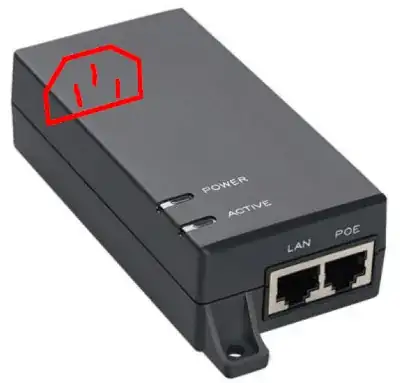
From http://gowifi.co.nz/power/active-poe-injectors/pt-pse100gf.html
A POE Injector is a box that adds the power, and has an ethernet in and out port along with a mains power lead. If you have more than 2~3 items to power then a switch might work out cheaper.
- POE-enabled switch (more expensive)
This functionality can be included in an ethernet switch like a Netgear 300 Series SOHO Unmanaged Switch (model GS308P)

from https://www.netgear.com/nz/business/wired/switches/unmanaged/gs308p/
Note the one above only has 4 POE enabled ports not 8.
Getting the power out of the cable:
If your remote device is POE enabled then the only thing required is to plug in the ethernet cable. The unit will negotiate POE with the injector/switch at the far end, then after a few seconds delay will turn on and start working.
Otherwise you'll need a POE Splitter which does the same negotiation but in a separate package.
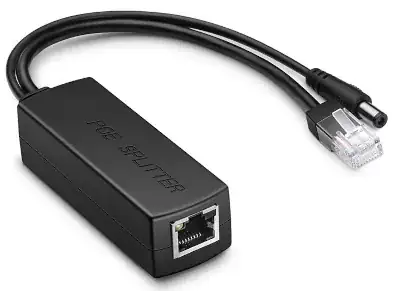
The voltage at the far end is set by the splitter, where 5V or 12V is common and sometimes has a USB micro or C plug or a barrel plug. You'll buy the splitter to suit your device's voltage requirement.
There are even cheaper "power over twisted pair" adapters or Baluns that forgo any kind of negotiation and just smash 12V onto the pairs using your existing wall PSU.
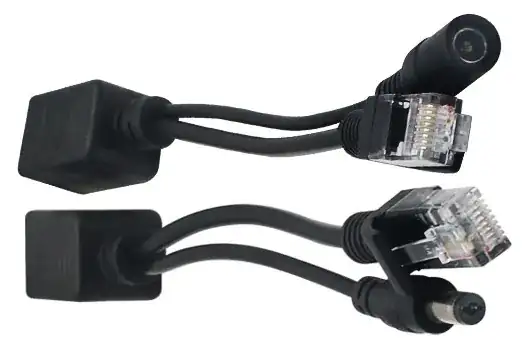
From https://www.aliexpress.com/item/4000575451173.html
Your existing PSU may not have the "oompf" to drive effectively the whole length of this "extension cable", so may not work, but they're cheap.
There are different POE standards that allow for up to 15W, then 25W, then 51W then 71W and doubtless more. Each increased standard requires better cabling and/or shorter maximal distances.
15W is more than enough to run a LED light fixture, and I have a raspberry pi and a 5TB USB hard drive running off one link.
In the linked question about "solar lights in shade" POE was workable.

The building in the left of photo has AC power, bridge is under 100 metres from building. A single POE run would supply enough power to run 4x3 watt 12V LED lights, or 3x5 watt lights. Running four separate wires would allow a single 15W light on each wire and some redundancy.