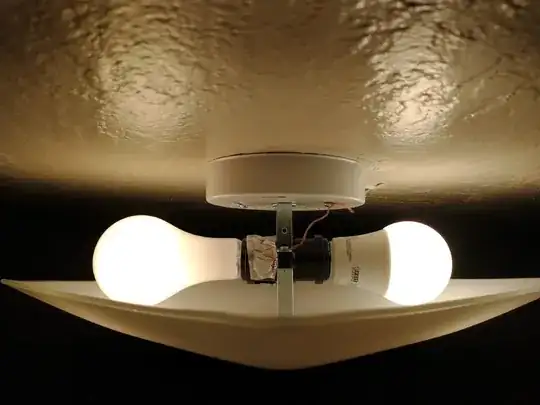
3

Photo for reference.

It may not be obviously visible in the shot, but the bulbs are pressing so hard into the edges of that fixture base that they barely make electrical contact before you feel you're about to break something screwing them in. At first I thought maybe that central bracket was installed upside-down or something, but I can't see any way either end would work for the other's job. I'm not even sure doing something like using tube-shaped bulbs would help. Honestly, I can't really tell how this whole fixture was supposed to work right in the first place.

Any ideas?

Atario
  • 239
  • 1
  • 8
  • Being a rental, do think your landlord has to do it/get electrician in to do it. You are only allow to change light bulbs in a rental by law. The round piece on the ceiling looks like a spacer/cover piece and should not be difficult to modify, but your landlord's electrician needs to do it. Light bulbs do come in different shapes, so that might be easier. – crip659 Nov 25 '21 at 12:35
  • 1
    Does the fixture have any labelling left anywhere which might indicate the type or wattage of the bulbs it's intended to use? – brhans Nov 25 '21 at 13:10
  • @brhans It has an embossed legend (which I can only see mirrored, from this side) saying it should only take 60W bulbs max – Atario Nov 25 '21 at 14:30
  • It’s true that this should be your landlord’s problem, and it’s also the case that candle shaped bulbs will fix it. However, if those aren’t bright enough, you could get normal bulbs to work if you put an extension (“medium base socket extender”, ie, https://www.1000bulbs.com/product/5834/ELEC-242500.html ) – Aloysius Defenestrate Nov 25 '21 at 15:01
  • 4
    the round can at top may be installed upside down – jsotola Nov 25 '21 at 16:45

4 Answers4

4

It just looks like you should have fitted candle bulbs, not 'standard'. It does look like one hokey piece of c*** anyway; shouldn't have incandescents that close to a papered/painted ceiling, plus the heat will perish the rose over time. Put candle LEDs in & it should be OK.

A candle will be about 35mm at its widest point, a standard incandescent will be about 40mm at the neck - your LED on the right is going to be fatter than that, but I don't have any of those on hand to measure.

Tetsujin
  • 11,467
  • 1
  • 20
  • 40
  • 3
    Can see the paint peeling over the left bulb, in fact. – Ecnerwal Nov 25 '21 at 13:57
  • These are the ones the landlord left in it. In fact the one on the left is a 30W/70W/100W three-way incandescent ("base down", it says), which means it's running at 70W — 10W more than the fixture's warning. :/ But won't any E26 bulb be about the same width at the neck? – Atario Nov 25 '21 at 14:38
  • I've never heard of a 3-way incandescent; but I'm UK. Here they're one wattage per bulb. Sure, all bulbs are the same at the narrowest point of all, but that's the socket fitting. They all get larger after that, but as you see your two regular bulbs are not the same after that point. A candle will be beyond its widest point by the time it has to pass under the rose, so should clear it. LEDs run [just about] cold, too, so won't burn the fitting or the paintwork. – Tetsujin Nov 25 '21 at 15:53
  • 3
    @Tetsujin 3-way incandescents were pretty common in NA for room/reading lamps. They have a button-in-button base with two filaments and three modes (low power filament ON, high power filament ON, and BOTH filaments on). In a normal non-3-way fixture only the central pin in the bullseye button makes contact so typically only the high power filament turns on in a basic fixture. – J... Nov 25 '21 at 21:21
1

You can get "light socket extenders" at most hardware stores, that would sit between the bulb and the socket and move the bulb out by about 1.5", but I'm not sure if they come narrow enough to avoid running into the same interference problem. You might want to check and see if you can find some that would work, since this would probably be the easiest solution.

1

Turns out jsotola's comment was the way I went. Although this necessitated doing a little more than is really my remit as a tenant, and I had to buy extra-long screws to accommodate it, it turned out pretty okay:

Photo for reference.

(TODO: replace the actual bulbs to my liking)

Atario
  • 239
  • 1
  • 8
0

That fixture was never legal.

It might be a foreign knock-off, but more likely it was thrown together out of parts, and some parts are missing/omitted.

Look at the blistering of the drywall paper above the incandescent bulb. It's illegal to sell fixtures that do that to a ceiling. Any fixture capable of taking incandescent bulbs is required to provide thermal protection to ceiling surfaces for the worst-case bulb someone might put into it. They allow a sticker that says "60W max" or some such. I've seen fixtures of a similar style, but they put a lot more space between bulb and ceiling. Perhaps someone "hacked" this fixture to get a low profile out of it.

Separate from that, this fixture was designed exclusively for incandescent bulbs, without the slightest thought for CFLs and LEDs, which have a wide base to house their control electronics. Or possibly, the way the lamp was misassembled caused an unusual spacing of the sockets.

Into the trash it goes.

Start with the color temperature you want.

On the left is 2700K if old incandescent, or 3000K if halogen (bulb within bulb). On the right is 4000K or 5000K - the markings on the LED will say for sure. People think they want colder (higher value) light than they really want. 4000K or 5000K is good workspace lighting, 2700K feels homey.

You can get any color temperature you want, as long as it's not black.

CRI is the quality of the light. Perfect is 100. Incandescent is 100. LEDs are 30-98 depending on what you pay for.

Now you can shop for a fixture you like. You can get sealed "bulbless" LED fixtures, which if competently made (i.e. not cheapo) will last long enough to make sense (i.e. longer than you'll live there). These fixtures have more design flexibility, since they don't have to account for a "worst case" thermal load.

Or you can get fixtures with special sockets like GU10 that will only accept CFL and LED screw-ins, and those too take advantage of not having to worry about a 60W/bulb thermal load.

Or (local Codes allowing) you can get traditional fixtures with Edison sockets, which are thermally rated for all that, and put any kind of bulb you please in them.

Tell the landlord the model you like and say "that one" and offer to help procure it (not the same as pay for it). It sits in a box until the next time the landlord's handyman or electrician is onsite for other work, then done. Pretty good deal for the landlord.

Harper - Reinstate Monica
  • 300,628
  • 26
  • 286
  • 734