No problem
In house wiring with flexible cables (NM/Romex), it is common practice to run circuits serially - going from one outlet to the next, etc. However, there is nothing wrong with wiring a circuit in a "Tee" configuration - branching in two or more different directions.
There is also nothing wrong with the "Tee" starting right at the breaker. This is why some breakers allow two wires, to spare you a splice in the panel (which is also allowed). It should be noted that this is one circuit. It just happens to tee at the breaker.
The most obvious application for a "Tee" at a breaker is electric heat. For instance a 30A breaker can support four 1500W heaters in various parts of the house.
The rules, though
**Every* wire in the entire circuit must match the breaker rating.
Why? In any circuit, you have no idea where a short will be. Worst case is a limited short which draws somewhat more current than the circuit rating. It's now a "race" to see which overheats first: the wire or the circuit breaker. For safety, that must be the circuit breaker.
So if the breaker is 30A, every wire in the circuit must be 10AWG. (we're presuming a circuit which branches, so the odd exceptions for certain single loads do not apply.)
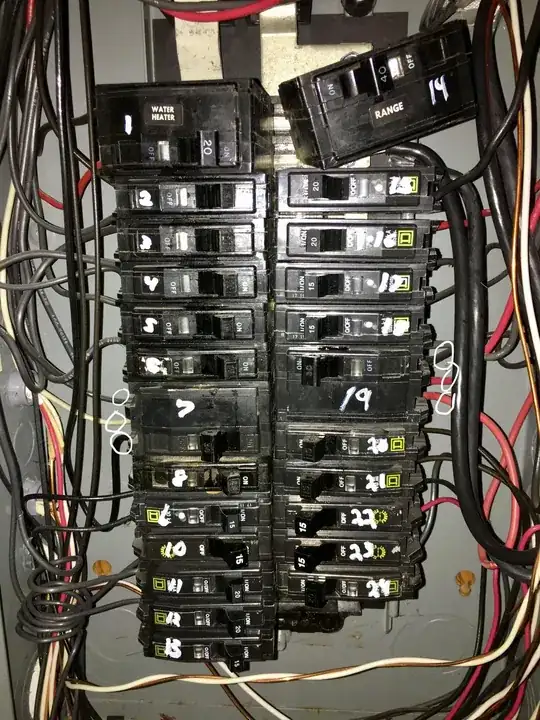
That funny business over on breaker 7, with the conspicuously thin wire, looks super wrong. That is an example of the amateur, horked-up, no good hackery that happens when you don't have readily-available spare spaces in your panel. This is why it's so important to get a Really, Really Large Panel.
I see where you're ripping out a 30-space Homeline panel, it's not obsolete and GFCIs are cheap for it. So I'm guessing either you need a bigger main, you prefer quality, or you're out of space. (double-stuff breakers are also plentiful and cheap for this panel, but that's ugly business.)
Since you're at 28, I'd aim for somewhat more than 40. Homeline doesn't go any bigger than 40. Others do but price is steep. You can also use subpanels to increase your available spaces, and you can do that later.