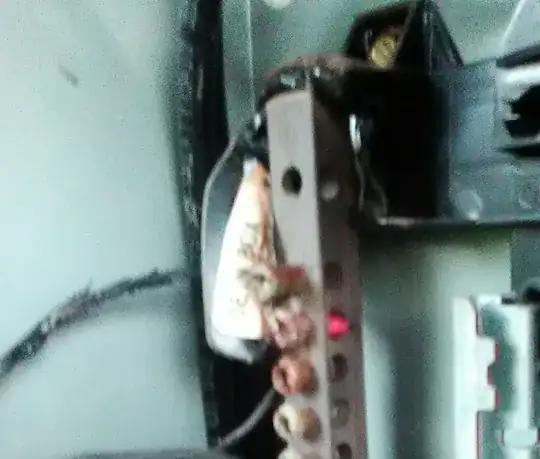
Glowing neutral bar connection. Double breaker
Asked
Active
Viewed 9,386 times
2

Machavity
- 24,720
- 7
- 42
- 93

Matthew Galvan
- 21
- 1
- 2
-
1What make/model of panel is this? Also, are we talking copper or aluminum wire here, and do you have a torque screwdriver available to you, or can you obtain one? – ThreePhaseEel Mar 31 '17 at 01:48
-
1Normally you need a FLIR to see a problem like this! LOL! Here, current is flowing in a way that is not protected by a circuit breaker. Check your meter, it's probably spinning like a top. We need a lot more information, what size is the breaker for instance? What size are the hot wires and what size is the neutral? Is the double breaker a duplex or a 2-pole? http://diy.stackexchange.com/questions/110151/what-is-a-tandem-breaker-aka-duplex-cheater-twin-double-stuff-etc – Harper - Reinstate Monica Mar 31 '17 at 04:47
-
3I am an electrician. I do not know the answer but I know I would be super nervous of that situation you have there. I am not especially squeamish but thats not good. – JollyGoodTime Mar 31 '17 at 06:42
-
1@Harper given the localization of the heat (heck, I think it look like an LED :-) ), It's more likely a high-ohm wire-to-nut junction, not a mega-Amp total current situation. – Carl Witthoft Mar 31 '17 at 14:53
-
Can you include a better photo of the wiring? – Tester101 Apr 01 '17 at 15:42
-
This is why NEC 2017 now requires torque screwdrivers for setting screw torques. – Harper - Reinstate Monica Feb 28 '21 at 00:12
3 Answers
3
This type of situation happens when the main neutral fails and all imbalanced current is redirected to a improper/loose connected grounding electrode, and/or improperly sized grounding electrode.
As mentioned by peter and Tester101, this requires immediate attention. Your 1st move is to cut off the main power. 2nd call a professional (unless you already have the main power off and are comfortable with Harper's advice).

ThreePhaseEel
- 83,293
- 29
- 137
- 230

Kris
- 4,837
- 2
- 12
- 32
3
Noting that OP has removed the service panel cover, he is presumably no novice, knows his limits, knows the urgency of de-energizing this circuit ASAP, and has already done so. Obviously if these things are not true, it's time to hire a professional, but time is of the essence: it's better to act now than wait until a pro visit can be scheduled.
If it's this hot here, it may be so elsewhere, starting a fire right now.
Note that this wire is overheated, and is now annealed, and is no longer suitable to continue in service. How much of the wire is damaged depends on the WHY? which was OP.
This will require it be fully de-energized and inspected.
A bad connection at the neutral bar
It's possible that everything is correct except, for whatever reason, this is a bad connection there at the neutral bar. It has much more resistance than it should, and it's making a lot of heat. In that case the heat would be localized to the bar proper, and would travel up the *highly conductive) copper wire only a limited distance.
I don't like the frazzled wire in the left, which is notably not white or gray. I don't know if this wire is involved. Generally when I see heat at a termination, the wire damage is not continuous, but more extreme near the bad connection. If that wire is involved, the damage looks uniform down the wire. You'd need to follow it to see whether that damage is continuous.
An overloaded neutral wire
In this case, the terminations are solid, but the panel is misconfigured and actual loads are placing a monstrous load on the neutral. In this case you will have damaged the entire length of wire and it will all need to be replaced.
You may notice neutrals do not have overcurrent protection (breakers). That is because each neutral is supposed to be partnered to only one hot (or a by-design MWBC which uses neutral only for imbalance current), and this limits the neutral current to that on the hot wire, which is the same wire size.
This can break several ways.
A neutral can be shared by several circuit's hots. For instance many electricians simply tie all the neutrals together just like they tie all grounds together. And this works if everything in the junction box is fed by one circuit. But if it's fed by two or more circuits, it results in parallel circuit paths. And if one of those neutrals then fails, it puts several breakers worth of "hot" on the same neutral. This can be even worse if a neutral was "stolen" to supply neutral for a heavy 30A-50A circuit. That can potentially be a lot of flow, with no overcurrent protection.
A multi-wire branch circuit can be erroneously punched down onto a duplex/double-stuff breaker instead of a 2-pole breaker. This often happens when panels are totally full, and a person installs double-stuff breakers in order to get 2 circuits into one space. A lot of people have no idea that a 2-pole and a double-stuff breaker are not the same thing. In this case, instead of a neutral carrying differential current, the neutral ends up carrying the sum of all currents.
I have seen both at once. I had three lighting MWBCs; 1-2-neutral, 3-4-neutral, and 5-6-neutral. They went to six single breakers, 1-2-3 down the left side, 4-5-6 down the right side. This meant 3-4 were on the same pole, an MWBC no-no! Even worse (actually better as it turned out), circuit 6 was inadvertently tapped into 3-4's neutral. So we had 3 hots sharing 1 neutral; fortunately there wasn't 20A of load on all three. That would've done exactly what you see.

Harper - Reinstate Monica
- 300,628
- 26
- 286
- 734
2
The picture is rather blurry, but lets start with First Principles: nothing in your breaker panel is supposed to be warm, never mind glowing. Turn the power off now. Not later, Now. Yes, all power, using the main breaker. And leave it off.
Second, it looks like the top 3 screws are different colours. Can't tell if it's rust, other corrosion or heat. All are bad. And the wire coming in from the left appears to have nasty insulation.
You need an electrician (unless you already have everything off that is).
ThreePhaseEel
- 83,293
- 29
- 137
- 230

peter
- 21
- 1
-
1While I agree with the urgency in this case, saying "hire a professional" is not our format here. You could literally say that for every single question. – Harper - Reinstate Monica Mar 31 '17 at 05:01
-
4@Harper While I usually agree. When your panel (or any part of your electrical system) is glowing red, it's time to call a pro. – Tester101 Mar 31 '17 at 10:12
-
3@Harper "In other news a local man was killed after someone online advised him to 'do it himself' over the advice of calling a professional in a dangerous situation." Knowing your limits is the first step in DIY. – Steve Mar 31 '17 at 13:17
-
2If you would like to shift consensus about "hire a professional" answers, you would do that in our meta area, here. https://diy.meta.stackexchange.com/questions/1155/hire-a-professional-answers @Steve has the right idea about knowing your own limits, i.e. it is applicable to oneself. Not to be confused with patronizingly "knowing" the other guy's limits based on 30 words he typed on a phone. – Harper - Reinstate Monica Mar 31 '17 at 20:18