Solar cell
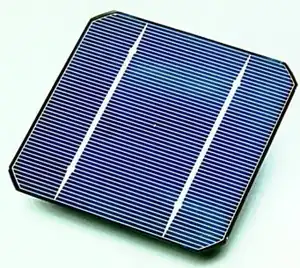

A solar cell, also known as a photovoltaic cell (PV cell), is an electronic device that converts the energy of light directly into electricity by means of the photovoltaic effect. It is a type of photoelectric cell, a device whose electrical characteristics (such as current, voltage, or resistance) vary when it is exposed to light. Individual solar cell devices are often the electrical building blocks of photovoltaic modules, known colloquially as "solar panels". Almost all commercial PV cells consist of crystalline silicon, with a market share of 95%. Cadmium telluride thin-film solar cells account for the remainder. The common single-junction silicon solar cell can produce a maximum open-circuit voltage of approximately 0.5 to 0.6 volts.
Photovoltaic cells may operate under sunlight or artificial light. In addition to producing solar power, they can be used as a photodetector (for example infrared detectors), to detect light or other electromagnetic radiation near the visible light range; also to measure light intensity.
The operation of a PV cell requires three basic attributes:
- The absorption of light, generating excitons (bound electron-hole pairs), unbound electron-hole pairs (via excitons), or plasmons.
- The separation of charge carriers of opposite types.
- The separate extraction of those carriers to an external circuit.
There are multiple input factors that affect the output power of solar cells such as temperature, material properties, weather conditions, solar irradiance and more.
A similar type of "photoelectrolytic cell" (photoelectrochemical cell), can refer to devices
- using light to excite electrons that can further be transported by a semiconductor which delivers the energy (like that explored by Edmond Becquerel and implemented in modern dye-sensitized solar cells)
- using light to split water directly into hydrogen and oxygen which can further be used in power generation
In contrast to outputting power directly, a solar thermal collector absorbs sunlight, to produce either
- direct heat as a "solar thermal module" or "solar hot water panel"
indirect heat to be used to spin turbines in electrical power generation.
Arrays of solar cells are used to make solar modules that generate a usable amount of direct current (DC) from sunlight. Strings of solar modules create a solar array to generate solar power using solar energy, many times using ann inverter to convert the solar power to alternating current (AC).
Dye-sensitized solar cell

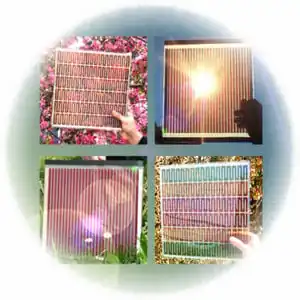
Dye-sensitized solar cells, or DSSCs, are a third generation[1] technology in the area of photovoltaics. They are classified as a type of thin-film solar cell,[2] meaning that they require only a small amount of material per cell compared to the first generation solar cells, making DSSCs lighter and more physically resilient than their first generation counterparts. They use a process similar to photosynthesis to produce electrical energy, making them an example of biomimicry.
Dye-sensitized solar cells are a promising technology because they are inexpensive and resilient, making them ideal for large scale and small scale applications.[3] However, they have lower efficiencies than most other types of solar cells, so they require more space than other types of solar cells to produce the same amount of electric energy. This disadvantage is offset by their low cost and greater resilience and flexibility.[4]
Gallium arsenide solar cells

The world's need for electricity is increasing everyday. And as we continue to produce this commodity by means that are limited, we are moving closer to a imminent disaster. It is a well know fact that fossil fuels are an expensive resource and will eventually run out. Due to this a movement must be started to promote, create, and sustain environmentally-friendly, effective, and renewable energy. The solution to this problem lies within technology that has been already created. This is no science fiction tale. Harnessing natures forces such as wind, water, and the sun, can allow for the production of electricity. These alternatives to burning fossil fuels may not be quite as effective; however their potential to be improved gives hope that one day these means may be used in a more widespread manner. This would create a cleaner environment for all and still yield electricity for those that require it.
I have chosen to discuss solar cells because we all can rely on the sun to keep shining and allow for solar power. We will have many years of solar energy. Just as plants have captured the sun's energy, so should we to provide for a clean and prosperous future. One of the new developments on the nano scale is the use of gallium arsenide in solar cells for improved electrical yield. Through this article I will outline the science of how a gallium arsenide solar cell functions, how to create one, and possible course development will go in the future.
Multi-junction solar cells
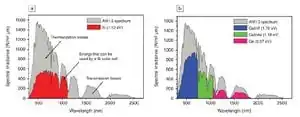
Multi-junction (MJ) solar cells use multiple semiconductor layers (subcells) to produce electricity at high operating efficiencies. Each layer has a unique band gap designed to efficiently absorb a specific segment of the solar spectrum. This has two important advantages over single-junction (SJ) devices: a wider range of absorption of incident photons as well as a more effective energy extraction from these photons. The lowest band gap of a MJ cell will be lower than that of a typical SJ band gap. Therefore, the MJ cell can absorb extra photons that possess less energy than the SJ band gap but greater than its own lowest band gap. The MJ cell will absorb the same photons more efficiently since having band gaps closer to the photon energy will reduce thermalization losses. For example, a SJ band gap of 1 eV could extract only 1 eV from a 3 eV photon with 2 eV wasted via thermal decay. On the other hand, a MJ cell with a top band gap of 2 eV will extract twice the energy from the same photon. Figure 1 illustrates the difference in energy absorption between a triple MJ cell and a SJ cell. The colored areas show the amount of energy that can be extracted by each cell. Table 1 gives the optimum band gaps and corresponding efficiencies for MJ cells. The table illustrates how additional junctions raise maximum efficiency. However, adding junctions also increases the device's complexity and cost. It must be noted that the use of concentrators gives an additional boost to potential efficiency.
See also
- Understanding Solar Cells - Article by Relief International
- ↑ http://news.xinhuanet.com/english2010/sci/2010-06/10/c_13342489.htm
- ↑ http://web.archive.org/web/20100529160135/http://www.eifer.uni-karlsruhe.de:80/162.php
- ↑ http://www.sciencedaily.com/releases/2006/09/060918201621.htm
- ↑ http://www.technologyreview.com/read_article.aspx?id=17490&ch=biztech&sc=&pg=1