Heat exchangers
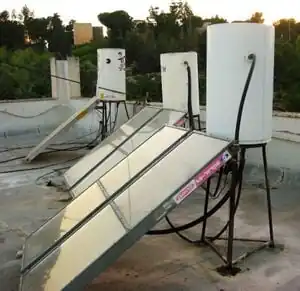
A heat exchanger is a device built for efficient heat transfer from one medium to another. The media may be separated by a solid wall, so that they never mix, or they may be in direct contact.[1] They are widely used in space heating, refrigeration, air conditioning, power plants, chemical plants, petrochemical plants, petroleum refineries, natural gas processing, and sewage treatment. One common example of a heat exchanger is the radiator in a car, in which the heat source, being a hot engine-cooling fluid, water, transfers heat to air flowing through the radiator (i.e. the heat transfer medium).
Types of Heat Exchangers
- Air source heat pumps
- Baffle
- Concentric tube heat exchanger
- Countercurrent exchange
- Deep water cooling
- Downhole heat exchanger
- Dynamic scraped surface heat exchanger
- Drain water heat recovery
- Energy recovery ventilators
- Grate heater
- Heat exchanger thruster
- Heat recovery ventilators
- Moving bed heat exchanger
- Pillow plate
- Plate fin heat exchanger
- Radiator
- Recuperator
- Regenerative heat exchanger
- Shell and tube heat exchanger
- Solar air heater
- Solar wall
- Thermal wheel
- Waste Heat Recovery Unit
See also
External links
- Microchannel heat exchangers
- Cogeneration
- Heat Exchanger Design and Operation
- Progressive Thermal Engineering
- Heat Exchangers Information and Resources
- Engineers Without Borders
- Engineers for a Sustainable World
- Heat Exchange Institute - Standards
- Heat Exchanger Effectiveness
- Heat Exchanger Calculator
Funding Opportunities for Engineers
- A list of funding opportunities, mostly in the United States, can be found here.
- The National Science Foundation (of the USA) is offering an environmental sustainability program that supports research in the area of Engineering for sustainable development.
- Canadian homeowners and small business owners can apply for grants and financial initiatives from Natural Resources Canada for improving energy efficiency.
- The School of Engineering Learn, Lead and Serve (LLS) Fund is a program at the Catholic University of Dayton in Ohio that offers $1,000 to $2,000 grants to individuals and groups for engineering research and community service. Grants and scholarships of this type are likely offered to students at other universities and colleges around the world.
- The Energy Innovations Small Grant Program provides grants for "small businesses, non-profits, individuals and academic institutions to conduct research that establishes the feasibility of new, innovative energy concepts".
Journals
Books
Education for Engineering for Sustainable Development
- Engineering for Sustainable Development is an Appropedia page with external links to education programs and courses.
- The Engineering Subject Centre in the UK offers resources for Education for Sustainable Development.
- The Applied Sustainability Research Group is a research group focused on education on engineering for sustainable development at Queen's University in Canada.
- The Association for the Advancement of Sustainability in Higher Education lists education programs in the United States.
- Mech425 is a course offered at Queen's University. Mech425 schedule is a complete schedule of the course curriculum with links to resources related to Open access, Appropriate technology, Green information technology, Solar energy, the Developing world, Socially responsible investing, Industrial symbiosis, Green design principles, and Sustainability in general.
Tools and Software
- The Open source engineering software page has many links to various open source software programs used in engineering.
- Thingiverse is a website where people can share digital designs. It also provides a way to upload non-compliant files to be shared on Appropedia pages.
- RepRap is an open source rapid prototyping system that is capable of producing its own parts and may be able to manufacture low cost heat exchangers
Heat Exchanger Development
- Engineering for Sustainable Development is an Appropedia page with external links to education programs and courses.
- The Applied Sustainability Research Group is an engineering group focused on engineering for sustainable development at Queen's University in Canada
- The Association for the Advancement of Sustainability in Higher Education lists education programs in the United States.
- The Engineering Subject Centre in the UK offers resources for Education for Sustainable Development.
Job Opportunities
- Enwave is an innovative company that provides deep lake cooling to its clients
- GEA Heat Exchangers is a manufacturer and repairs heat exchangers
- Industrial Heat Transfer is a designer and manufacturer of heat exchangers for large facilities.
- SustainJobs.com is a search engine for jobs in the sustainability field.
- The Canadian International Development Agency has jobs, internships, and volunteer positions for Canadians interested in development work.
- Village Earth has volunteer opportunities in appropriate technology and other areas.
Videos
Work to be done
Stubs that need to be expanded:
There are lots of missing pages in Appropedia for heat exchangers, so feel free to pick one and share your knowledge!
Footnotes
- ↑ Kakaç S., Liu H., (2002). Heat Exchangers: Selection, Rating and Thermal Design (2nd ed.) CRC Press. ISBN 0849309026. 311-317.