Denmark community action
The aim of this page is to recognise, celebrate and encourage the self-empowerment of community agency networks (CANs) and community groups' activism for climate, environment and many other sustainability topics across Denmark.
 ‘Insanely tasty green food’: how the meaty Danes embraced a world-first plant-based plan, theguardian.com (Jan 31, 2025)
 - European nations must end repression of peaceful climate protest, says UN expert, theguardian.com (Feb 28, 2024)
- The Beyond Oil and Gas Alliance now has 10 core members (Costa Rica, Denmark, France, Greenland, Ireland, Portugal, Quebec, Sweden, Wales, and Washington State), two associate members (California and New Zealand), and five "friends of BOGA" (Chile, Fiji, Finland, Italy, and Luxembourg)., beyondoilandgasalliance.org (Nov 16, 2022) — BOGA is an international alliance of governments and stakeholders working together to facilitate the managed phase-out of oil and gas production, led by the governments of Denmark and Costa Rica
Networks and sustainability initiatives
- Gaia Trust, charitable entity supporting sustainability projects, especially the ecovillage movement.
Visions
The Next Denmark, alternativet.dk
Cohousing

Sættedammen is a cohousing community in Denmark. Established 1972, it is the world's first community defined as cohousing, following a path similar to the founders of Bryn Gweled Homesteads in the US 1940. The membership comprises approximately 60 adults and 20 children in 35 households. Sættedammen is an open, non-dogmatic community, based on social activities (various interest groups, a daily common dinner, common celebration of holidays and cultural events).
There are precedents for cohousing with the Siheyuan, or quadrangle design of housing in China which has a shared courtyard and is thus similar in some respects to cohousing. Unlike the utopian movement in 18th and 19th century, the three villages of Arden, Ardentown, and Ardencroft, Delaware founded at the turn of the 20th century as well as Bryn Gweled Homesteads founded in 1940 in Southampton, Pennsylvania incorporate private homes on commonly owned land while promoting cooperative values. These cohousing communities were established in part based on Henry George’s single-tax theory. In the 1920s in New York, the rise of cooperative apartment housing, which now make up over 70% of all homes in Manhattan, similarly incorporate shared facilities, self government and greater social interaction but rarely include prospective residents participation in the design process nor the intentionality of current cohousing. Swedish social scientists and architects advanced common space coupled with private homes, followed by the modernists in the 1930's-'50's who spurred the building of many cohousing communities, such as Marieberg in Stockholm.
Hundreds of cohousing communities exist in Denmark and other countries in northern Europe.
Community energy
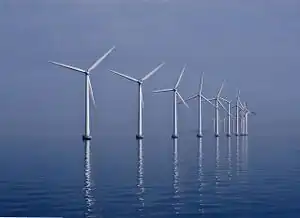
According to Renewables First, the proportion of energy generated through community-owned production amounts to 86 percent in Denmark. When communities take energy generation into their own hands, it connects the user to the source.[1]

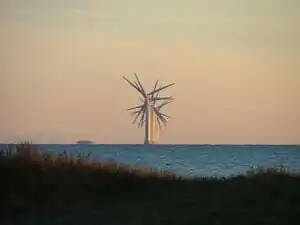
The 140% Renewable Energy Island of Samsø. The small island of Samsø has reduced its carbon footprint by 140%[2] in the past decade. In 1997 the Danish government held a competition. They challenged contestants to convert their energy supply to 100% renewable energy within a 10 year period.
The small island of Samsø, a 20x6 mile islet nestled between the hustle and bustle of Copenhagen's island, Zeeland, and the mainland Jutland won the bid. It is only accessible by ferry and has no original power plants of its own. This combination made Samsø an ideal candidate for Eco-Revolution.[3]
Energinet, real-time overview of Denmark's power sector
Solar energy: Denmark reached its year 2020 government goal of 200 MW solar cell capacity in 2012, and has 500 MW solar capacity in 90,000 private installations as of 2013. Danish energy sector players estimate that this development will result in 1000 MW by 2020 and 3400 MW by 2030.[4]
Climate action
Denmark's green house gas emissions per dollar of value produced has been for the most part unstable since 1990, seeing sudden growths and falls. Overall though, there has been a reduction in gas emissions per dollar value added to its market. It lags behind other Scandinavian countries such as Norway and Sweden.[5]
About ProjectZero, Sonderborg
Ethical consumerism
Buy Nothing Day (Danish), Buy Nothing Day (English)
Sustainable transport activism
Smart Mobility Project (Danish), Aarhus
Waterways: The only manmade waterways in Denmark are some tourist canals, like the canals in Copenhagen and the Odense Canal. There is also a 160 km route through the Limfjorden in northern Jutland linking the North Sea to the Kattegat.[6]
Cycling activism
Bicycling in Denmark is a common and popular recreational and utilitarian activity. Bicycling infrastructure is a dominant feature of both city and countryside infrastructure with bicycle paths and bicycle ways in many places and an extensive network of bicycle routes extending more than 12,000 kilometres (7,500 mi) nationwide (in comparison Denmark's coastline is 7,314 kilometres (4,545 mi)). As a unique thing, Denmark has a VIN-system for bicycles which is mandatory by law. Often bicycling and bicycle-culture in Denmark is compared to the Netherlands as a bicycle-nation.[7]
Food activism
Ecological agriculture and production is significant on Samsø, with a broad network of cooperating associations. It comprise farming of a large variety of vegetables, grains and fruits, livestock meat and products (lambs, sheep, yarn, cows, pigs, horses, donkeys, goats, chickens, eggs), a dairy, a brewery, restaurants and cafés, candy production, permaculture and forest garden experiments. There are several plans for extending the overall ecological production and broaden the industry (a slaughterhouse, orangery, forest gardens and education), with a wish for creating more jobs and stimulate settlements on the island.[8]
About Denmark
Denmark is a Nordic country in Northern Europe. It is the metropole and most populous constituent of the Kingdom of Denmark, also known as the Danish Realm, a constitutionally unitary state that includes the autonomous territories of the Faroe Islands and Greenland in the north Atlantic Ocean. Metropolitan Denmark, also called "continental Denmark" or "Denmark proper", consists of the northern Jutland peninsula and an archipelago of 406 islands. It is the southernmost of the Scandinavian countries, lying southwest of Sweden, south of Norway, and north of Germany, with which it shares a short border. Denmark proper is situated between the North Sea to the west and the Baltic Sea to the east.
The Kingdom of Denmark, including the Faroe Islands and Greenland, has roughly 1,400 islands greater than 100 square metres (1,100 sq ft) in area; 443 have been named and 78 are inhabited. Denmark's population is close to 6 million, of which roughly 40% live in Zealand, the largest and most populated island in Denmark proper; Copenhagen, the capital and largest city of the Danish Realm, is situated on Zealand and Amager. Composed mostly of flat, arable land, Denmark is characterised by sandy coasts, low elevation, and a temperate climate. Denmark exercises hegemonic influence in the Danish Realm, devolving powers to the other constituent entities to handle their internal affairs. Home rule was established in the Faroe Islands in 1948; Greenland achieved home rule in 1979 and further autonomy in 2009.
A highly developed country, Danes enjoy a high standard of living, with the country performing at or near the top in measures of education, health care, civil liberties, democratic governance and LGBT equality. Denmark is a founding member of NATO, the Nordic Council, the OECD, OSCE, and the United Nations; it is also part of the Schengen Area. It maintains close political, cultural, and linguistic ties with its Scandinavian neighbours, with the Danish language being partially mutually intelligible with both Norwegian and Swedish.
Near you
See also
- Topic overview: Networks
References
- ↑ @shareable, Oct 26, 2021
- ↑ http://www.travelblog.org/Europe/Denmark/Region-Midtjylland/Sams-/blog-440546.html
- ↑ http://www.moneyweek.com/investments/commodities/how-denmark-is-leading-the-way-in-renewable-energy.aspx
- ↑ wikipedia:Energy in Denmark#Solar
- ↑ wikipedia:Denmark#Environment
- ↑ wikipedia:Transport in Denmark#Waterways
- ↑ wikipedia:Transport in Denmark#Cycling
- ↑ wikipedia:Samsø#Sustainable production and agriculture